Wednesday, April 5, 2017

Wittenberg


 Good morning from Wittenberg!
 [The view from our window!]


 This ancient town is the place where Martin Luther settled as a monk and began to both study and teach and preach.  After a good night's sleep and a wonderful buffet breakfast we set out on a bus for a short ride to the home of Martin Luther his wife, Katherine whose statue greeted us, and nine children.


In the old monastery we saw the pulpit from which Luther preached at the Town Church of which he was pastor.

 And here we see what started all the trouble!  The Cash Box for the buying of indulgences.  Our guide was very knowledgeable about the Reformation and life in the monastery before Luther encouraged all the monks as well as the nuns from a nearby convent to leave.

 During this time ordinary people could not read or write.  So the stories of the bible were done as paintings to help educate them against the evils of sin.  This painting by Kronos has never needed repair or restoration or even cleaning because of his remarkable skill and technique.  It teaches the ten Commandments by showing the good people in light colors with angels at their shoulders
 and the bad ones in black or yellow with devils grinning!


Katherine made them wealthy.  The former nun turned the former monastery into t boarding home for students.  She brewed their own beer and grew much of the food she served.  Luther was allowed by the King to keep the monastery as the family home after the reformation began even though the King was a devout Catholic and remained so.  He admired the learning and teaching ability that Luther had and did not want him as an enemy.  Above is the iron stove used for cooking and heating the large stone building.  Below is the doorway to Luther's study.  It was found accidentally when the interior was being restored.  It is in this study where Luther continued to translate the Bible from the original Greek.


I learned a great deal about Martin Luther's history which is, of course, a history that forever changed the world.

After the short ride by bus to the docking point we joined the ship's crew for lunch aboard as we sailed along to Torgau where we would dock overnight.  Elva and I enjoyed our lunch from the light buffet served in the lounge so that we could enjoy it in a leisurely manner while watching the world go by - literally!

The afternoon passed quite pleasantly as we got to know our fellow passengers better.  The river cruises always seem to draw from many countries and different ages, although usually most are retired.  We spent time with Norman and Gerard from Coventry, England.  Norman is in his 80's and although quite hard of hearing and slow to move around, he was delightful. His son is with him as Norman's wife died a year ago.  Gerard is so much fun to be with and had us frequently in hysterics, especially with the differences of American and British English.


Torgau was a pretty little place of narrow lanes and houses identified by decorative art.  It is here at the river that the Russian and American troops met up on April 25, 1945. 


The Russians took over an accordion  factory.  Not a surprise, but that so many knew how to play the difficult instrument was quite a surprise!  There was a woman singer who had been imprisoned in the large fortress but the Russians freed her so that she could perform with and for them in an impromptu concert on the square.

After the war the American Battalion presented general Eisenhower with the makeshift flag that they had made to signal the Russians that they were not German and the meet-up was successful and momentous.   It was on a bed sheet and they used paints they found at a local store.  At first the Russians were suspicious but it was, in the end, the beginning of the end of the War.

Arriving back at the ship, Janos and his crew had prepared Goulash and fresh bread for a festive end to the day steeped in history.


All in all another lovely day of leisurely exploration of two classic German towns.

Monday, April 3, 2017

Setting Sail At Last

We were on our way early Monday morning after checking out of the Berlin Hilton.  Elva and I are still in Bus group  A and will continue that way until we leave Prague at the end of the week.  Not so lucky is that our group always leaves for the day 15 minutes before the other.  It is good that they stagger the group but I am sleepy today.

Since our river cruise is on the Elba and it does not flow in Berlin we are driving out to meet it in Wittenberg.  Our first stop was in Potsdam which is really just a suburb of Berlin.  The wealthy area has beautiful homes which were mostly undamaged during the war.  All of Berlin is pretty much a reduplication of pre-war planning and design.  It was rebuilt to replicate the original city, but Potsdam is an original city filled with large, spacious homes of brick and balconies.

At the edge of Potsdam we crossed The Bridge of Spies.  Here Gary Powers was exchanged for a Russian spy. It became the exchange point routinely used.  It gets a little confusing as you drive in and out of east and West Germany and I am never sure which I am in. 


 A view of the nearby 'lake house' of one of the Nazi friends of Hitler.


We continued on stopping at the Sansoucci Palace to see the outside and view the extensive gardens.  We walked to the guest house which was built to give the tiny 12 room main house a better view than that of a swamp.  Known as the New Palace there were four guest suites, 1st and 2nd floor, on either side of the central ballroom and dining room overlooking the most beautiful English Gardens. Each suite took a full floor and had its own living room, dining room, card room, music room and his and her bedrooms. If you were a guest you were able to invite others to be your guest as well since there was a guest room within the guest suite.  Each also had indoor plumbing with toilet and ornate tiled bathtub.  Food was cooked between the main house and guest house and brought to basement chef's pantries to be finished and prepared to serve.

Frederich the Great had it all built after the Seven Years War and the showpiece was completed in six years.


Here is a link to view the interiors of at least the Grotto Hall and the Marble Hall.  The King wanted the seashell room on the first floor with open access to the gardens for this summer home so insisted the 80 ton Marble Hall be built above it.  Maybe not a good idea!  The halls recently reopened after the floor/ceiling need extensive repairs!

The Grotto Hall is marble and sea shells!  Stunning.  I could not take pictures of the Grotto Hall of the New Palace but you can find some here. 

We had a lunch stop in a lovely little town steeped with noble history.  Elva and I avoided crowded restaurants and enjoyed the sunshine with our picnic. We then continued on to Worlitz to a pretty little but very modern old home filled with history of an interesting family.  The wife even had her teeth filed to narrow points, as was the fashion, to please her husband.  But Louisa had only one son and was soon relegated to her own home on the property in an old convent where she happily enjoyed her own pursuits.  The husband soon moved to another, larger home across the lake where he had a succession of mistresses and children, all of whom were daughters.  All seven mistresses were also named Louisa!

The house we visited was the marital home built when he was so in love with his bride to be. And they did live there happily for a little time.  But this Frederich loved technology and clever construction better than any person.  The house was always open to visitors who were also interested in construction innovation.  Doors folded flatly into the walls because recessed depth was added into the frames to accommodation the door knobs.


 All the wallpaper, art, and furniture are original to 1773!
 The white spaces are raised decoration the green is Trompe L'oeil.

 Wine fridge.

 Cove ceiling.


 There was a collection of beautiful sculpture like the bust in  the library of a famous author.....


and he saved his favorite pieces for his bedroom!


Several rooms had an early version of a Murphy Bed built in.  Some folded down and some accordioned from the walls.  There was a refrigerator that looked like a simple cabinet.  It was in the dining room for the wine.  In his bedroom he worked Hugh Hefner style - from his bed. But since he was German it was a bit more structured.  One end had a built in desk and the other the wardrobe.  A trundle pulled out to welcome friends.


On the way out past the espaliered fruit trees and lovely lake and vineyard I had Elva pause by the bus showing our next Viking cruise which will be on the Viking Sky ocean liner.  Our bus that we always used pictured the Longship.


At long last we reached Wittenberg and caught our first sight of our home for the next week - the Viking Beyla.   In typical Viking fashion we were greeted by the Hotel Manager, Chef, Maitre'd, and even the Captain.


Also, as typical for me, we do not have the most spacious cabin but I was very happy to have a large window on this newly built, two year old ship. 


 Some of the people of Wittenberg had taken comfortable seats at the riverside to see the parade of passengers joining this week's cruise.

We found what will be our favorite spot this week  - the Aqua Vite Terrace.  When we were lucky we claimed the comfortable rocking chairs and snuggled under warm wool blankets while sailing.

 Sebastion, whom we had already spent time with in Berlin, remains as our Program Director but now wears his officer's stripes while on board.

 The Captain and all the officers were introduced and we could already see the cheerful comradery that they had which would prove to be so  much fun as the trip progressed.

 The Captain made a short welcome speech and toasted a happy journey.  He turned out to be so jovial and was everywhere around the ship when not in in the wheelhouse.

 Here Captain Vavel demonstrates the life jacket.

Following the Welcome Dinner was some Renaissance entertainment in the spirit of the hometown of Martin Luther from which we sailed away!


Sunday, April 2, 2017

Weekend in Berlin - Part Two

Sunday dawned bright and clear and another tour of Berlin was on the agenda.  Although our Viking included tour duplicated many of the sights but we learned many new things.  Lothar was again the guide on our bus with our Group A of about 30 people.  We enjoyed it all and had so many personal stories of life in the East and the West since he was seven years old when the Berlin Wall was erected. We did go to some outlying parts of the city to where the Jewish community was living and there is currently a new synagogue.  Elva and I decided that since we will be experiencing the Ghetto sites in Poland on our extension we would skip the museum and so we did not go back to it after the tour ended.

When our bus reached the center of town again we stopped for a comfort break.  Elva and I took the opportunity to visit the new church that replaced the one that was destroyed but left as a reminder to have no more wars.  The new bell tower is closed for renovation and rests under a bright orange tarp and is nicknamed The Lipstick.  On the other side of the old church and tower is an octagonal black and dark windowed church nicknamed The Powder Box.   But when you enter the church the tiny windows are in reality the most brilliant Cologne Blue and the cross is resplendent against it!

We stopped at the Brandenburg Gate and could clearly see how closely the gate stands behind and to the side of the Reichstag. Lothar pointed out the spot where President Reagan made his famous 'tear down this wall" speech.  The platform actually had to be in the middle of the street in order to see the gate behind him and be in the West Berlin territory.  To his right was the building that was the heartbeat of the Eastern Government.

Elva and I both needed some 1 and 2  Euro coins for tipping so we each bought a cone of delicious gelato with a 20 Euro bill.  Mine was excellent lemon flavored.  Back at the hotel, now that we had had our dessert so to speak, we put our feet up for a while, ate our sandwiches, and took a few minutes to regroup before setting out once again on our own.

We simply crossed the street in front of our hotel and in the Gendarmenmrkt there was a demonstration being held.  The square is named because there was a time when some 20% of Berliners were French.  The Gendarmes were based in this square.  None were needed today because this was a celebration of 60 years of  the EU.  Children and adults were waving small flags and speeches were greeted with cheers.


You know from before that the center of the square is the Konzerthaus and either side has the matching German and French churches.  The Deutsch Dom is a museum exhibition about the architecture of the city of Berlin.  It was quite interesting as we followed the winding staircase down the ground floor.  Paper and wooden models were on the top floor, then pictures, lots of pictures. I liked peeking out the window to take pictures of the back of statues with lightening rods adding extra support, and the ground below.


As we walked through the city on our way to dinner, mostly in search of where Elva had the delicious soup the other night I enjoyed taking a few Farewell Photos of Berlin as we are leaving in the morning.


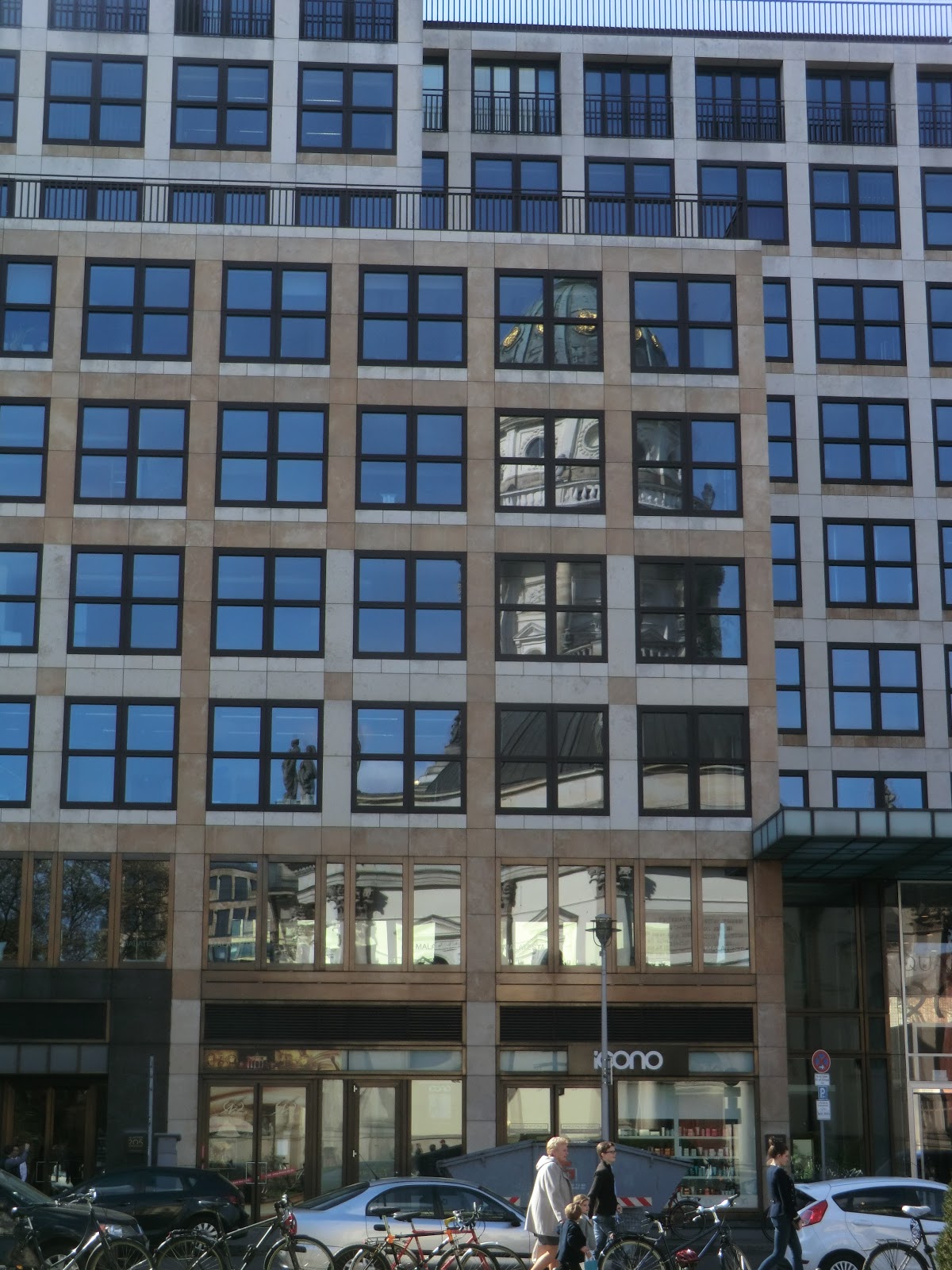
 I do like to take photos of the reflections of the old in the facades of the new.

We didn't find the soup kitchen, as they are called, and many places were closed.  Berlin is a very religious city and so many places close early on Sunday if they are even open at all.  We joined the throngs at the McDonald's by Checkpoint Charlie and then headed back to the Hilton. 

It didn't take long to organize for the early putting out of our luggage tomorrow morning.  At last we head to the Viking Beyla!